
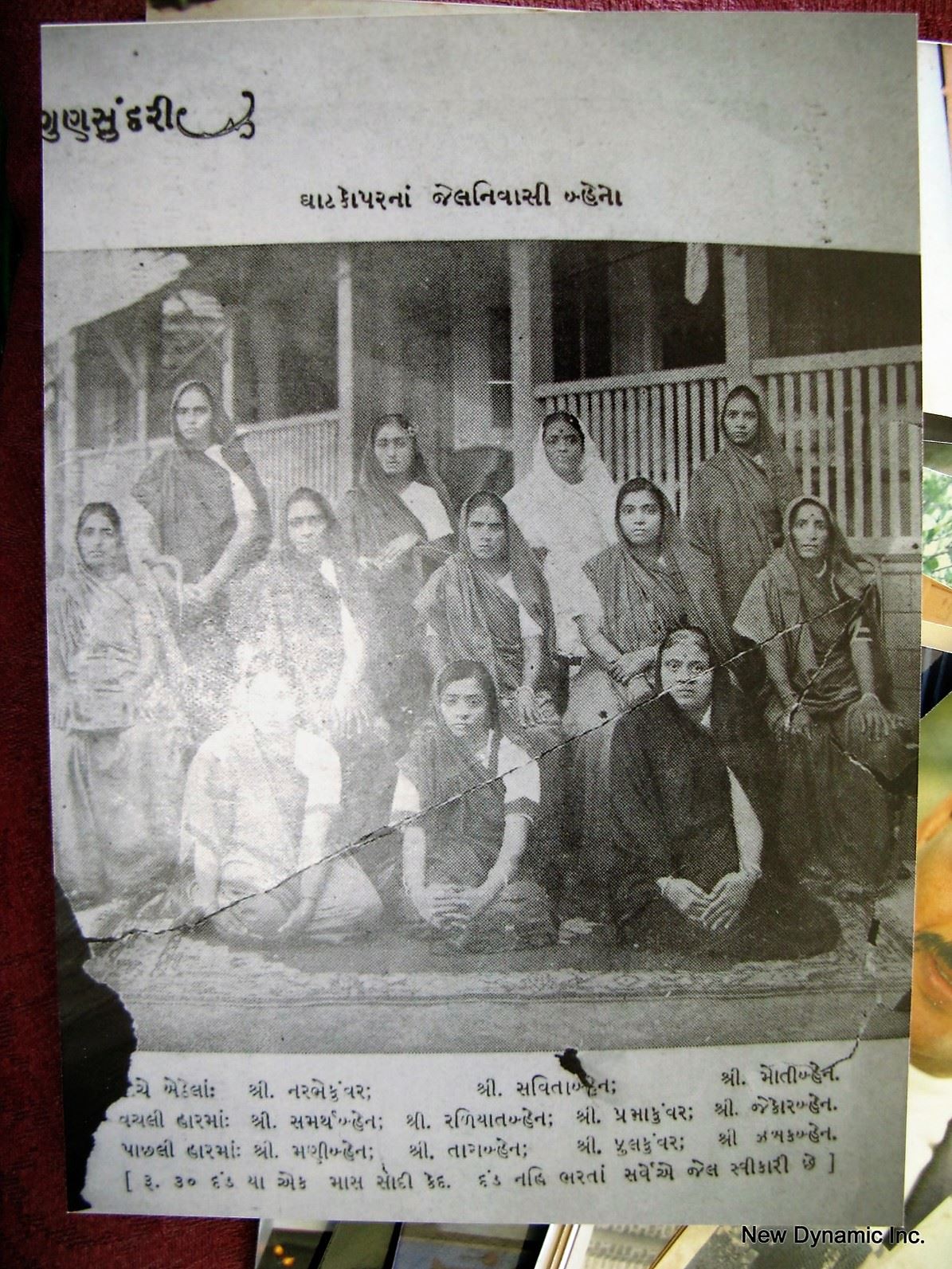
The Most Outstanding were Savita ben, Moti ben, and Manjulaben.

Motiben (Moti Kaki chimanlal Mehta and Savita Kaki both spent over a month Jail in 1930

Nautamlal Mehta-Kamdar’s daughter Manjula ( Maya) was Mahatma Gandhi’s favorite daughter. Seen in the above Picture with Mahadev Desai is one of the rare pictures Mahatma has seen in a few people groups. 10–100 people always surround Mahatma. This Photo was brought for us by my daughter Anjali from my uncle’s collection.

When My uncle Moolshankar Met Mahatma Gandhiji, Mahatmajee wrote this note in Moolshankar’s Diary about his sister, Manjula:
“Manjulane barobar olakhun chhun. Ane tene deekareenee jem maarun man haree leedhun chhe. Evaa jo, tame ho, na ho to thana jeva bano ne raho. — Baapunaa aasheervaad.”
Read and interpreted adequately by great Gandhian scholar: Dr. Varshaben Das of Rajhat Gandhi National Museum, New Delhi: “I know Manjula very well; she won my heart as my daughter. If you are like her and NOT like her, then try to be like her and stay that way. ‘ Baapu’s blessings.
For additional context, Varshaben is the granddaughter of great Amritlalbhai Sheth and the daughter of Mohanlal Sopan. Both my uncles, Vajubhai and Moolshankarbhai, and aunt, Manjula (Maya), gave their whole life to Gandhian ideas and moments without seeking any office. They worked directly with the underserved individually; no one knew their work, but thousands of people benefited.

Savita Kamdar and Motiben Mehta Sitting on the Ground in the Center is SAVITA BEN, AND FAR RIGHT IS MOTIBEN.both are the most remarkable women of the Nautamlal Mehta-Kamdar family. Both opted to spend time in Jail for over a month.it is remarkable being Jain women in 1930s India; their courage, dedication, and devotion to Freedom of independence, and generous mind support Mehta-Kamdar women within our. Savita Kakai kept doing Her “Seva” for Downtrodden people in Chennai until the late 1970s; she was a trusted administrator and later Anna durai time. Once upon time, their shop was trendy, “Kamdar Optics.” no more. They have no more connection there.

This picture must have been taken around 1840. Nautamlal’s Mother is on the far left, sitting very confidently without paying attention to the presence of The British political agent Colon Lang. This is most likely a picture in actual photos of any Jain woman; the camera was first invented in 1830 ( in those times, women would not even dare to look at the nonfamily man; here they are sitting with White Political agents of the British)

IndiraIndira Gandhi Sharda Manilal Mehta in the center she Hosteted Lots of freedom of India leader in Myanmar from late 1920 to 1950 during 2nd world war when Dr P.J Mehtas and Manilals 33 00 acres Mills looted Manial, His Brother Vaju saved 5000 Hindus in their mill 3300 acres land and six Rohingya Muslim. Shardas and her Mill worker were helping the injured sick and arranging their food and supplies until all had escaped in the middle of the night for their life… For details info with pictures, click here.

Three brave Jain women wrote a few letters to Netaji in their blood. I requested Netaji order them. They are prepared to die for Mother India.
, Lilavatiben Chhagan Lal P Mehta and her two daughters Neelam and Ramaben. Ramaben just died in February 2022 at the age of 94 in Mumbai.
Dr. P.J. Mehta (brother-in-law-in-law of my grandfather Nautamlal Mehta) had been a known nationalist and supported Gandhi financially. The family-owned, in Partnership with Nautamlal Mehta’s Son Manilal, about 3,300 acres of land in the Pyapon district of lower Burma.
His son, Chhagan Lal PranjivaMehtaMehta’sese family, supported the Azad Hind Sarkar; his wife, Mrs. Leelavati Mehta, and her two daughters, Neelam Mehta and Rama Mehta were the first to join Rani Jhansi Regiment in Burma. Both the daughters had been inspired by their mother, who has been described as a formidable lad’’ by Captain Lakshmi Swaminathan, who had even. Leelavati Mehta also recruited many other girls and women for the Rani Jhansi Regiment. Rama and Neelam returned to their home when the Rani Jhansi Regiment was disbanded,

Anjali Niranjan Manilal Mehta
Here are Some Rare Historical Photos of Great Netajis and Mahatma Gandhi that are only in our Possession, Thanks to My Daughter’s severe adventure without asking the US.
These are from my Uncle Vajukaka, who spent his whole life helping and teaching Myanmar People in the phyapon area. He spent most of His life in Burma (Myanmar). He Never Married and was living alone in Myanmar. When he died in 1995, he left his Personal Diary and some photos with his Neighbors. He told him,” You keep this eternally; someday, my family members will come and pick you up.” I tried in 1998 twice to Go to my Birth country from the USA, but the circumstances did not allow me.
My daughter Anjali must be a Tool or destiny ( Nimit) to bring a treasure for me from Nowhere in 2006. Anjali was 18 years old in 2006 and studied in Singapore; without our direction or instruction, she went for the first time. Still, it was a communist moment, which was very restrictive; therefore, she could not go to my Uncle Vaju Kakas’ hometown, Pyapon.
In 2009, She went again, without letting us know, with her own money, on a very challenging and risky tour to Myanmar. From Rangoon, she had to use a Bus, a boat, a motorbike, and police help (without any communication in English). She finally reached Pyapon to bring me a” Goldmine of info.””” on our family’s historical photos.
When she went on a Myanmar trip, she had yet to learn how she would get there. My daughter Anjali went twice to bring his Diary and some Personal effects; we found some very Rare and Historical photos in his Diary,
Dr. P.J Mehta’s youngest son, Maganlal, who was the leading Operator and owner of their Diamond and color stones business, and his wife( Manjula), the daughter of Nautamlal B Mehta and (my faiba), were very Gandhian followers and supported Netaj” effort with his new path spiritually to wish him success but never involved in nonviolent thinking.